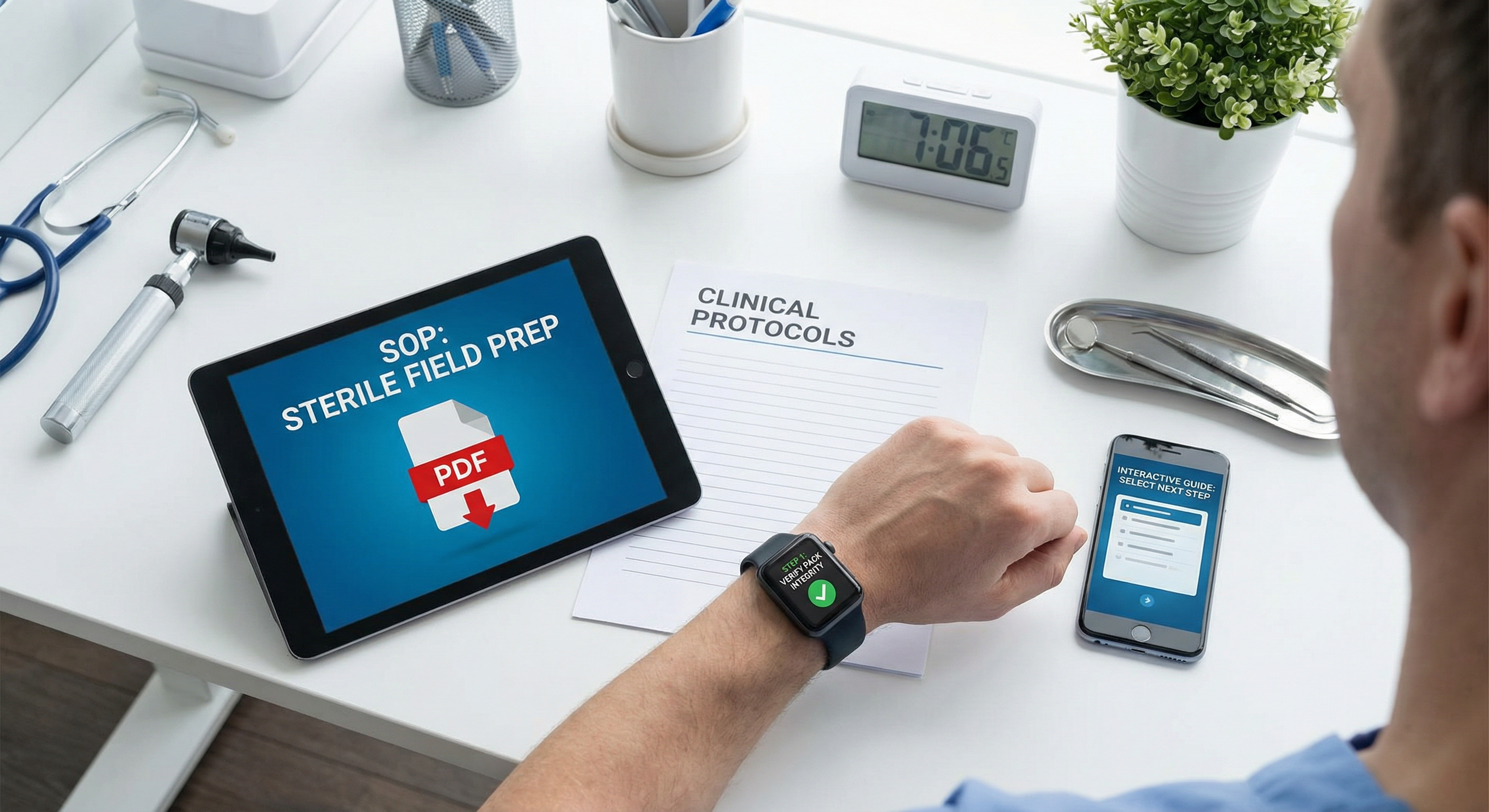
The document you already have
Most organisations do not lack written procedures. They have them, correctly written and approved, and that document stays the reference. What is harder is keeping the procedure in front of people at the moment the work is done — the distance between the page and the bench.
So MedNAIS™ starts from what you have. In the console or the app you upload a PDF, a Word file, plain text or photos of the pages, or paste a link, and get back a draft split into steps, each showing the passage it came from. Scans and photos are read by a vision model, and a page it cannot read is flagged rather than guessed at.
What the model actually does
It reads the extracted text and proposes a sequence of steps: what to do, in what order, what has to be confirmed, where something has to be timed. It is good at structure and at turning prose into instructions somebody can follow one at a time.
It is not reliable about the things that matter most. A language model can state a quantity, a temperature or an interval incorrectly, drop a control the source document requires, or attribute a requirement to a standard that does not contain it. None of those errors looks like an error on the screen; they look like ordinary steps.
Why a person has to publish it
A draft in MedNAIS is not runnable. Somebody qualified in that work has to read it in full and publish the version before anybody can perform it, and the product will not publish a version on its own — there is no setting that turns the gate off, and we are not planning one.
This is deliberately inconvenient. The alternative is a plausible-looking instruction reaching the hands of somebody who has no way to know it was never checked.
- Read the draft against the source document, not against your memory of it.
- Check every number, every interval and every named material.
- Ask whether a step can be carried out by somebody who has not read the whole procedure.
- Publish. What people run is the published version, and it is fixed until you publish another.
Where you have no document
We keep no library of standards and do not supply, license or resell them. Where you have nothing to hand, MedNAIS can name the documents that ordinarily govern that kind of work and check each name against the register of the body that issues it, so you see the designation, title and edition the register returned. Obtaining the document remains yours to do.
Try it before you commit anything
The demonstration needs no account: four short procedures in a warehouse, a production line, a laboratory and a building site. Then read how a step is written, which is where most of the value is won or lost.
Topics
See MedNAIS itself
One product with four parts and one account. The demonstration needs no account at all.