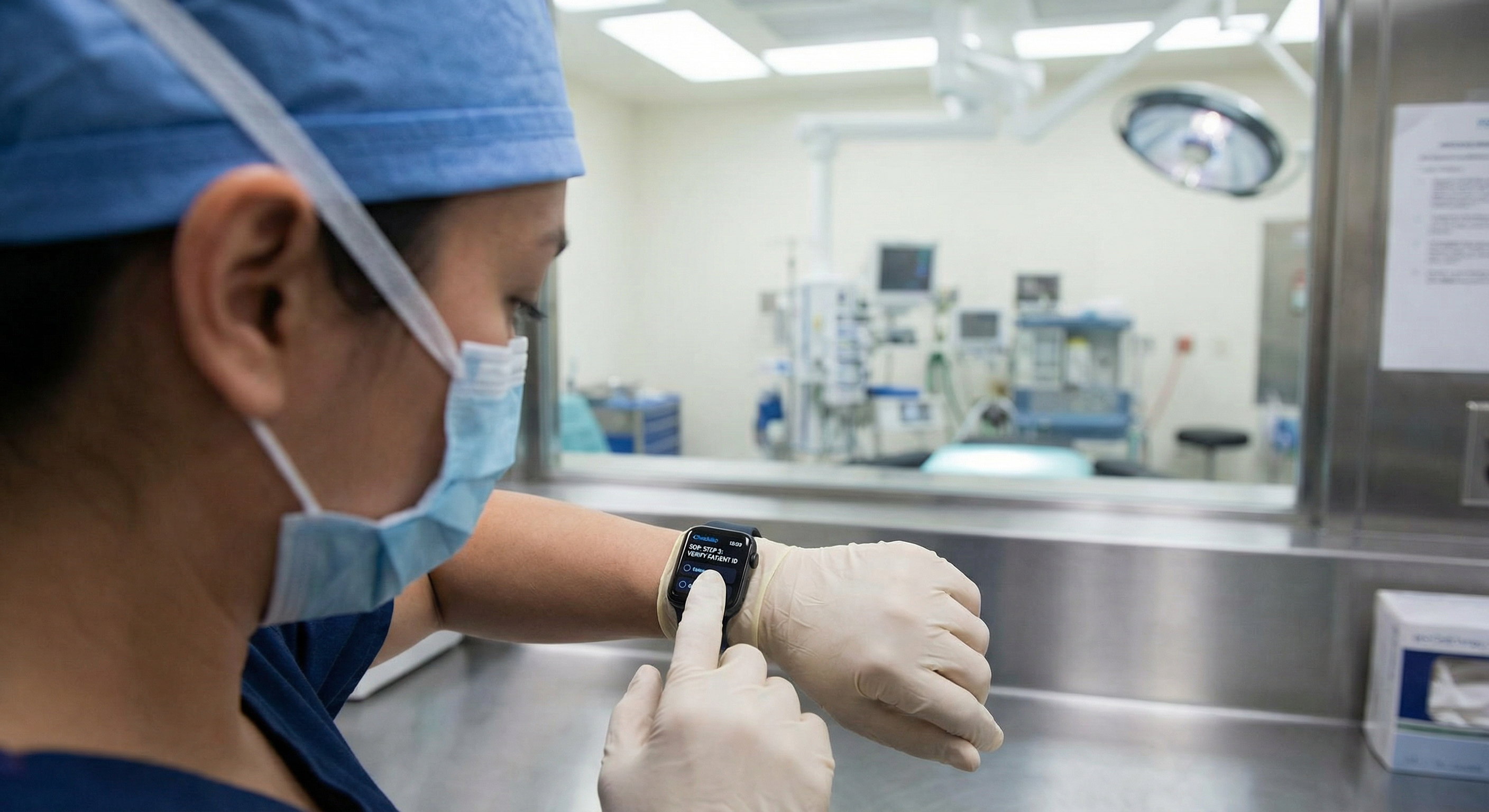
One screen, one action
A step is read by somebody wearing gloves, holding something, mid-task, once. It is not read the way you wrote it — carefully, at a desk, with the whole procedure in view.
The practical test: can this step be carried out correctly by somebody who has read no other step? If it depends on remembering step four, it is not one step.
The five kinds of step, and what each is honestly for
- A confirmation — "done". Cheap, and the right default. Its evidence is weak: it records that somebody pressed a button.
- A checklist — several things that must each be ticked. Use it where the order does not matter but completeness does.
- A timed wait — the product holds the step for a set duration. Use it where the duration is the requirement, not where you would merely prefer people not to rush.
- A yes-or-no answer — a fork recorded in the record. Use it where the answer changes what happens next, or where you will want to know afterwards how often it was no.
- A code — scanned with the camera on Android, or typed in. Use it where the identity of a thing matters and a name is not enough.
Scanned or typed is recorded, and not judged
When a code is entered, the record keeps whether it was scanned or typed in by hand, because they are evidence of different strength. It passes no judgement on either, and neither should a dashboard: a code is typed in when a label is damaged, when the light is wrong, when the camera fails, and occasionally for reasons somebody should ask about. Only a person who knows the work can tell those apart.
Optional steps, and going back
Mark a step optional and it can be skipped — and the skip appears in the record, which is the point. An optional step honestly marked is better than a mandatory step routinely ignored.
When somebody goes back a step at the point of work, the earlier attempt stays in the record rather than being overwritten. A correction is a fact about how the work went, and erasing it would make a messy run look tidy.
Language
The interface runs in English, Russian, Spanish, German, Polish and French. Your procedures are in whatever language you write them in; we do not translate them, because a mistranslated instruction is worse than one in a second language.
Topics
See MedNAIS itself
One product with four parts and one account. The demonstration needs no account at all.